Pharmacology Investigation 003
Clutch Round Pharmacology: Pouches and Performance Under Pressure
Capsules are a pre-match decision. Pouches can be used between maps, mid-session or before a decider. A look at nicotine and L-theanine pouches, what the absorption data show, and why arousal follows a curve, not a line.
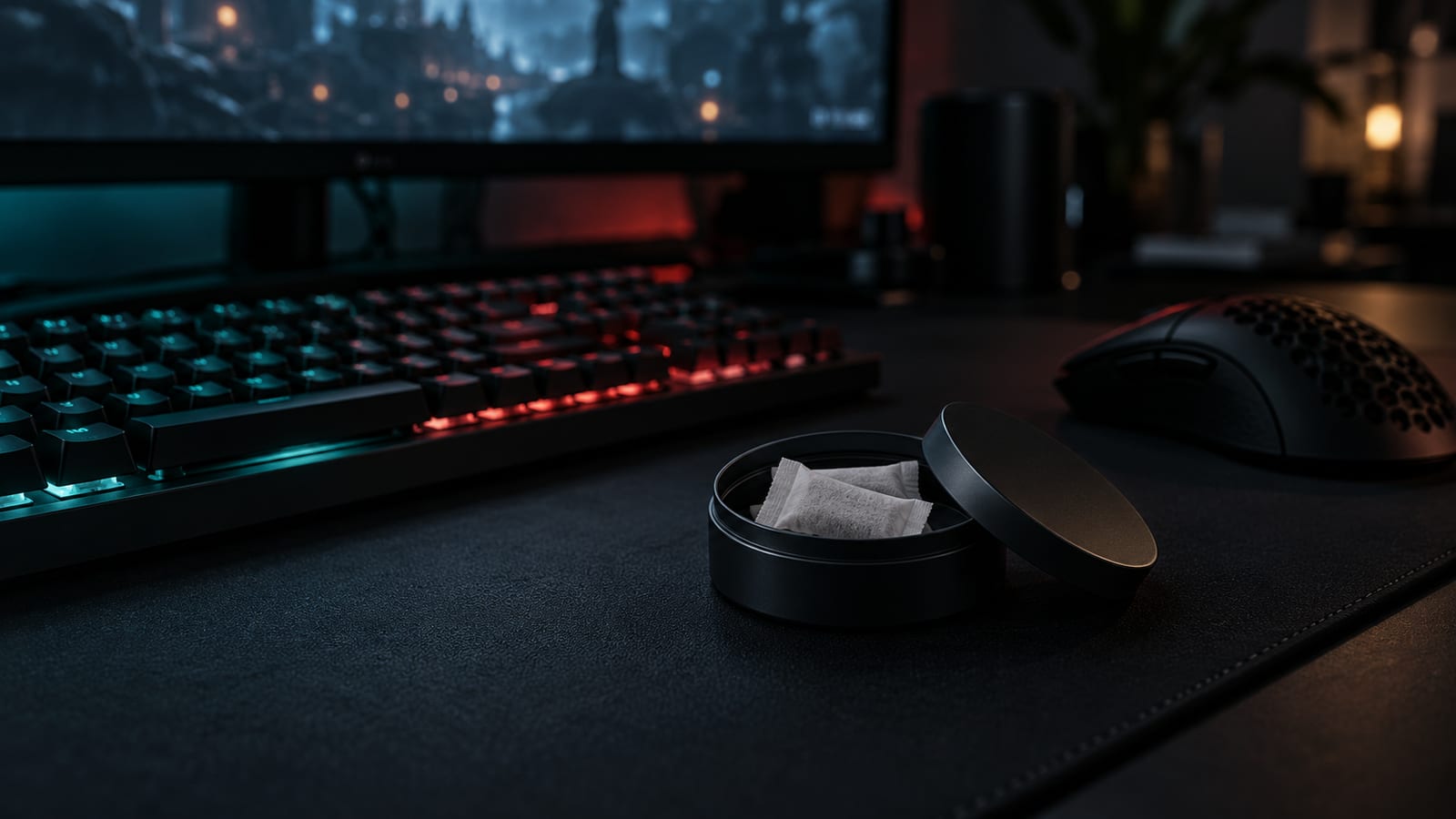
Most performance pharmacology in esports is planned before the session. A coffee, a capsule or an energy drink is taken in advance, and the player hopes the timing lines up with the moment it matters. Competitive play does not run to that schedule. Overtime, a decider map or a long ranked session puts the important moment hours after the plan.
That is why pouches have become one of the most interesting developments in the space. They allow in-the-moment pharmacology: a compound taken at the point of need, with no drink, no swallowing and almost no interruption.
Why the route of delivery matters
A capsule has to be swallowed, dissolved in the stomach and absorbed through the small intestine before passing through the liver. For L-theanine, that journey is well measured.
Scheid et al., 2012
Moderate relevance to competitive play
Kinetics of L-theanine uptake and metabolism in healthy participants are comparable after ingestion of L-theanine via capsules and green tea
Journal of Nutrition 142(12):2091–2096
- Sample
- n = 12, Healthy adults
- Design
- Randomised crossover
- Intervention
- 100 mg L-theanine as capsules vs green tea; a subgroup also took 50 and 200 mg capsules
- Result
- Plasma L-theanine peaked about 0.8 hours after intake by either route (24.3 and 26.5 μmol/L). Exposure rose with dose.
- Limitations
- Small sample. Measured blood levels, not brain levels or performance.
A peak at about 48 minutes means a capsule taken mid-session does little for the next map. A pouch works through a different route. It rests against the gum, and its contents can pass through the oral lining directly into the bloodstream, bypassing the gut and the first pass through the liver.
For nicotine, this is well established. The pharmacokinetic data also show that “fast” is relative:
- In one clinical study, plasma nicotine peaked about 22 to 26 minutes after starting a pouch, compared with about 8.6 minutes for a cigarette.
- An industry study of several commercial pouches reported peaks at 60 to 65 minutes, partly because pouches are used for a long period rather than consumed at once.
- In a randomised crossover study, Lunell and colleagues (2020) found that higher-strength pouches produced plasma curves close to traditional moist snuff, with nicotine extraction from the pouch higher than from tobacco products.
Effects begin as nicotine starts to arrive, well before the peak. The point is control: a pouch can be started, held or removed in the moment.
L-theanine in a pouch
L-theanine pouches are newer than nicotine pouches. Players already used L-theanine in capsules and drinks for its calm-focus profile and its well-studied pairing with caffeine. Putting it in a pouch brings the same delivery advantages: no swallowing, discreet use mid-session and a dose that can be timed to the match rather than to the schedule. Alyva, for example, makes pouches containing pure L-theanine with no nicotine.
Whether L-theanine crosses the oral lining as efficiently as nicotine has not yet been measured in a published study. Nicotine is unusually well suited to absorption through the mouth; amino acids are generally less so. So the faster onset of an L-theanine pouch is a strong rationale, not a trial result. What is certain is the practical gain: a format that fits the moment of play, with none of the dependence risk of nicotine.
Nicotine: real effects, real costs
Nicotine is the most potent cognitive compound commonly found in pouches, and the most double-edged.
Heishman, Kleykamp & Singleton, 2010
Moderate relevance to competitive play
Meta-analysis of the acute effects of nicotine and smoking on human performance
Psychopharmacology 210(4):453–469 doi:10.1007/s00213-010-1848-1
- Sample
- 41 studies, Healthy non-smokers, or smokers deprived for 2 hours or less
- Design
- Meta-analysis of double-blind, placebo-controlled laboratory studies, 1994 to 2008
- Intervention
- Nicotine vs placebo across nine performance domains
- Result
- Significant improvements in fine motor abilities, alerting and orienting attention, and short-term episodic and working memory. Because participants were not in withdrawal, the authors concluded these represent real enhancement.
- Limitations
- Laboratory tasks. Effect sizes vary by domain. A later systematic review called nicotine's cognitive effects inconsistent.
The domains that improved (fine motor control and alerting attention) are exactly the ones that matter in an FPS. That is the case for nicotine. The case against is equally clear:
- Dependence develops quickly. Once a player depends on nicotine, much of its apparent benefit becomes relief from withdrawal. They need it to reach their normal level, not to exceed it.
- Withdrawal impairs attention, which is the opposite of the goal, and it arrives at the worst moments: travel days, tournaments with restrictions, mornings.
- Cardiovascular effects. Nicotine raises heart rate and blood pressure.
- It is not for non-users. Starting nicotine to gain a competitive edge trades a small, uncertain lab effect for a dependence that is hard to undo.
The arousal curve
Both compounds connect to one principle: performance does not increase steadily with arousal. It follows an inverted U. Too little arousal produces lapses and slow reactions; too much produces tension, rushed decisions and poor fine motor control. The shape of this relationship was first described more than a century ago and holds broadly across cognitive tasks, although the exact curve varies by task and person.
The clutch round is where this becomes practical. A player in a 1v3 is often already near the top of the curve. A stimulant at that moment can push them over it. A compound associated with calm, focused attention aims at the opposite problem: keeping arousal in the usable range. That is part of why L-theanine fits the in-the-moment format so naturally, while nicotine needs much more care.
Summary
| Question | What the evidence says |
|---|---|
| Do pouches deliver compounds through the mouth? | Yes, well established for nicotine |
| Is pouch nicotine instant? | No. Peaks range from about 22 to 65 minutes depending on product and use |
| Does nicotine improve attention and fine motor skill? | Yes in lab studies of non-deprived users, with dependence as the major cost |
| How fast does capsule L-theanine peak? | About 0.8 hours |
| How fast does pouch L-theanine act? | Not yet measured; faster onset is a strong rationale |
| Should non-users start nicotine for performance? | No |
The pouch format solves a real problem in competitive play: timing. What goes in the pouch decides whether that solution is a smart one.
References
- Scheid L, Ellinger S, Alteheld B, et al. Kinetics of L-theanine uptake and metabolism in healthy participants are comparable after ingestion of L-theanine via capsules and green tea. J Nutr. 2012;142(12):2091–2096.
- Clinical pharmacokinetic study of two nicotine pouch variants compared with a cigarette, 2022. Full text: PMC9217727
- McEwan M, et al. Conference abstract comparing nicotine pharmacokinetics of several commercial pouches with a cigarette. CORESTA, 2022. coresta.org
- Lunell E, Fagerström K, Hughes J, Pendrill R. Pharmacokinetic comparison of a novel non-tobacco-based nicotine pouch (ZYN) with conventional, tobacco-based Swedish snus and American moist snuff. Nicotine Tob Res. 2020. doi:10.1093/ntr/ntaa068
- Heishman SJ, Kleykamp BA, Singleton EG. Meta-analysis of the acute effects of nicotine and smoking on human performance. Psychopharmacology. 2010;210(4):453–469. doi:10.1007/s00213-010-1848-1
NeuroFPS publishes scientific analysis, not medical advice. Nothing here is a recommendation to take any substance or a dosing guide. Responses vary between individuals; speak to a doctor or pharmacist before changing anything you take.